
As voice assistants like Alexa and Siri become even smarter, marketers must adapt to ensure their brands are found.
You’ve been blogging for SEO for a while, but despite your best efforts, your blogs just aren’t ranking. What’s worse, previous posts that did well aren’t anymore. What’s going wrong?
The answer may be keyword cannibalization, when two pages with similar intents and target keywords essentially “eat” away at each other. But will similar content get penalized every time, and what can you do to stop it?
In this post, I’ll cover:
- Blogging for SEO
- What Keyword Cannibalization Is
- What You Can Do to Prevent It
Blogging for SEO & Keyword Cannibalization
We often recommend a blogging strategy for our clients interested in SEO services. Why? It can help your website:
- Build topical authority
- Rank for more keywords
- Provide information for site visitors
- Improve overall SEO
- Attain more backlinks
While aimlessly blogging can have some benefits (like demonstrating your expertise on a subject), without a proper strategy, you run risks like repeated content and keyword cannibalization.
What Is Keyword Cannibalization?
Keyword cannibalization happens when you use the same keyword too many times across different pages on your website that all serve a similar purpose. Whether product pages, service pages, or blogs, keyword cannibalization can happen for a few different reasons, such as:
- Publishing similar pieces of content
- Optimizing web pages for the same target keyword
- Failing to redirect an old page to a new version
Why Is Keyword Cannibalization Bad?
When two (or more) web pages use the same target keyword with the same intent, they’ll compete against each other. This means that while one may rank, the other won’t. In some cases, neither will rank.
Keyword cannibalization may not always lead to your site being penalized and prevent your pages from ranking. However, it does give you the opportunity to consolidate your content into one comprehensive guide for your audience, helping strengthen its SEO value and bringing in more organic traffic to your site.
How to Avoid Keyword Cannibalization

Thankfully, if several of your web pages are cannibalized, you can do something about it. Here are some options for both existing content and for creating posts in the future.
Use an SEO Tool
It’s a good idea to find out why your pages are being flagged for keyword cannibalization, and for that, you’ll need an SEO tool like SEMRush. Performing a Site Audit will reveal any pages with too similar content. Then, take the appropriate route to resolving it.
Perform a Manual Content Audit
If you have a lot of existing content and don’t want to invest in an SEO tool, you can still perform your content audit manually. Here’s how to do it:
- Make a list of all your current blogs
Create a spreadsheet with the URLs, H1s, and target keywords for all of your existing blogs.
- Identify similar topics
If any of the topics overlap, group them together, whether in a new tab of the spreadsheet or by colour.
- Compare target keywords
Look at the target keyword for each of the similar topics. Make note of their search intents.
- Compare blog content
What kind of information is included in each blog post? Make note of this in your spreadsheet.
- Create a kill, combine, keep list
Then, create a kill, combine, keep list.
- Kill: If the search intent and the blog content are exactly, or very close to, the same as another higher-performing blog, delete it.
- Combine: If one blog has the same target keyword but low performance, combine it with a higher-performing blog about the same or similar topic. Redirect the lower-performing page to the higher-performing combined page.
- Keep: If your blog’s content is quite different and your target keyword is a long-tail variation of other keywords, keep this blog. If it hasn’t performed well, add it to your list of re-optimizations.
Factor in Intent
To prevent the issue in the future, make sure your blog strategy factors in search intent.
You can use the same target keyword on multiple web pages IF the pages fulfill different search intents (navigational, commercial, transactional, informational).
Fulfilling an informational intent (e.g., how-to pages, guides, etc.) and commercial intent (service or product pages) is completely doable without cannibalizing your target keyword IF that keyword is both informational and commercial.
How to find search intent: SEO tools like SEMRush and Ahrefs can help you determine a keyword’s search intent, but if you don’t want to invest in these tools, you can look at the SERP (search engine results page) for what types rank in the top 10.
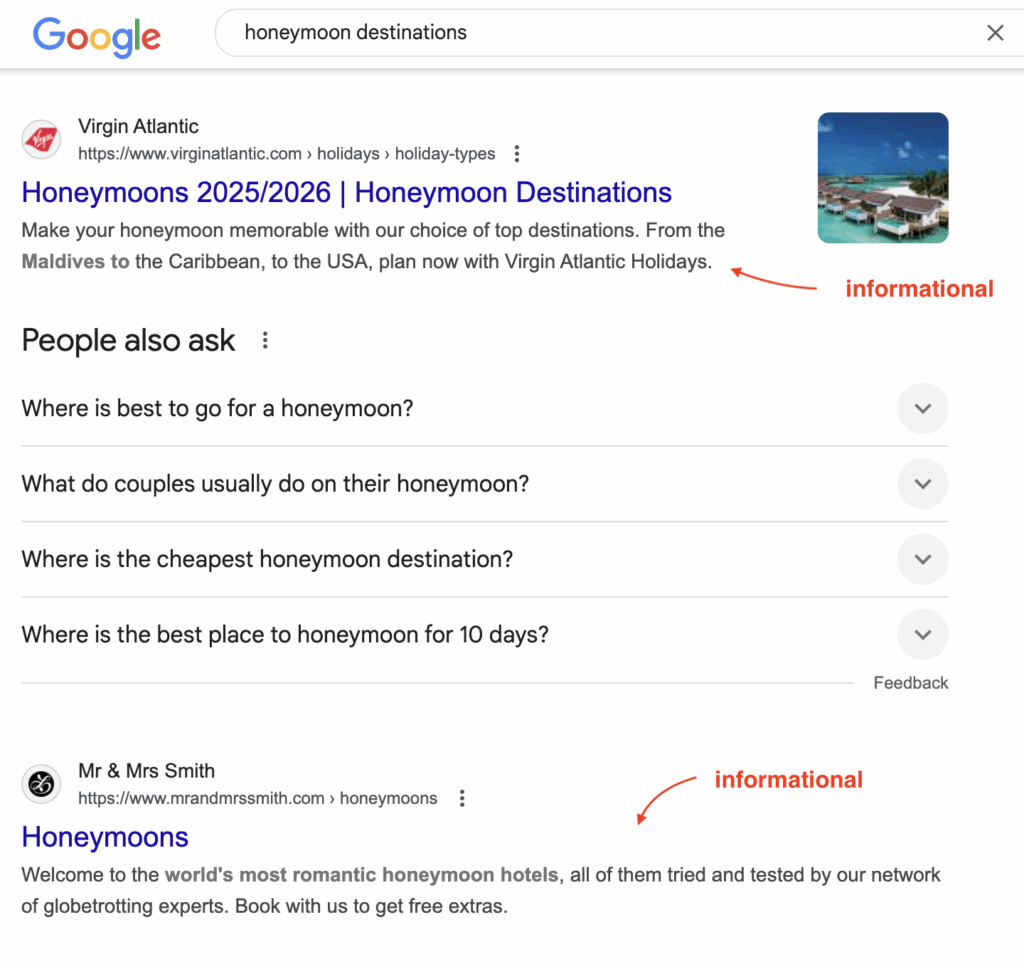
Read this guide on the different types of search intent.
Create a Content Strategy

Victory loves preparation, and there’s no better way to ensure you don’t experience keyword cannibalization than to create a content strategy. Whether you prepare yours every 1, 3, or 6 months, the practice can help you prevent overlapping content and build topical authority.
While I suggest exploring a more in-depth guide on creating a content strategy, I’ll give you a quick walkthrough of what you can expect.
Before you start, though, the first two things you must do are:
- Perform a content audit
- Create a kill, combine, keep list, and execute it
It’s always a good idea to understand what content is already on your site and how it’s performing before creating new content. Once you’ve handled your kill, combine, keep list, you can start on your new content strategy.
Here’s what to do:
- Identify your content goals
- Identify your content pillars
- Brainstorm supporting topics
- Break those topics down further, if needed
- Perform topic research and analyze the SERP
- Select a target keyword that meets the right search intent
- Organize your content into a calendar
Creating a content strategy is easier with SEO tools, but you can still manually perform topic and keyword research—it just might take longer.
Get Help with Your Content Strategy
Looking for a little help with blogging for SEO? We’re your team. We specialize in producing content that will help you build topical authority, be recognized as an industry expert, and get more organic traffic to your site.
Keyword cannibalization is just one of the many issues that adopting a content strategy can prevent. Contact us for a comprehensive review of your website’s current SEO and to identify steps to improve it.
Apply this to your business
A 45–60 minute working session with a senior marketing leader. No obligation, just a clear next step.